
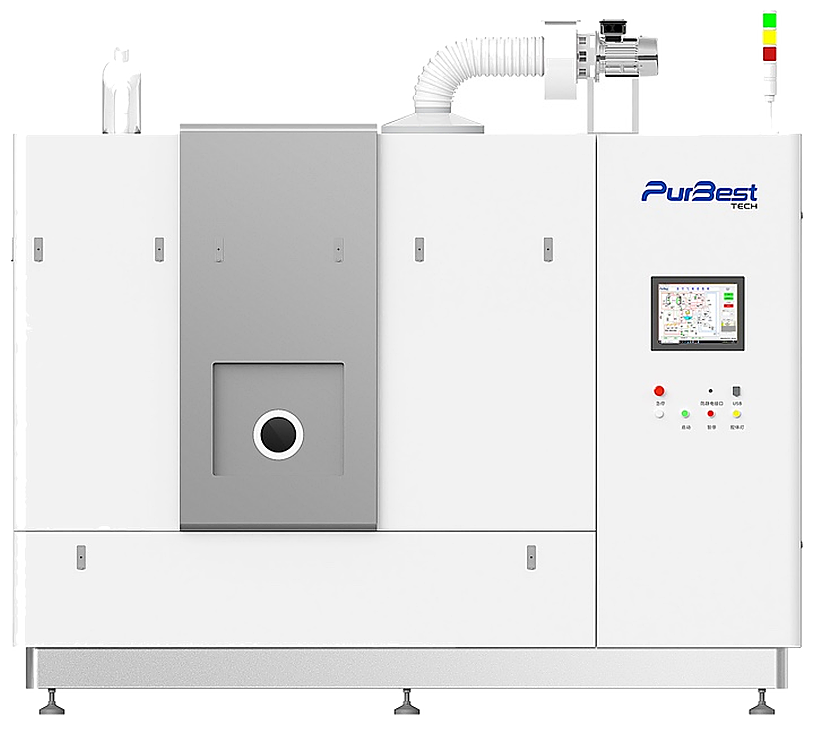
The NanoVapor is a vacuum vapor phase cleaning system designed for precision cleaning of microelectronics assemblies where water-based processes cannot reach. It operates under vacuum to eliminate air pockets, ensure complete solvent penetration into micro-gaps, and produce fully dry assemblies with no residual moisture — critical for BGA, flip-chip, 3D IC, and low stand-off packages.
Why NanoVapor Exists
Traditional aqueous cleaning cannot penetrate stand-off gaps below 0.3mm (0.012″). Water’s surface tension (~72 mN/m) physically prevents it from entering the micro-gaps under BGA, QFN, and flip-chip packages. The NanoVapor uses low-surface-tension solvents (~13-20 mN/m) combined with vacuum operation to clean where water cannot.
Key Specifications
| Vacuum Level | Below 50 mbar (0.73 psi) — entire cleaning and drying cycle |
| Operating Temperature | 62-80°C (144-176°F) — above solvent flash point |
| Process Type | Vacuum vapor phase cleaning with continuous distillation |
| Solvent Compatibility | HFE-based solvents, co-solvent formulations |
| Filtration | Standard 25μm (0.001″); optional 1μm (0.00004″) or 5μm (0.0002″) |
| Construction | 304 stainless steel — all pipelines and tanks |
| Control | Industrial computer with touchscreen interface |
| Solvent Tanks | Two storage tanks + one distillation tank (standard configuration) |
| Process Data | Parameter setting, status monitoring, and data management |
Control System: Windows OS with touchscreen HMI — programmable recipe storage/recall, cycle data logging, password-protected process parameters, and exportable production records for traceability (IPC-6012, MIL-STD-883, AS9100).
Applications
- BGA cleaning — flux residue removal under ball grid array packages (stand-off gaps 0.1-0.3mm / 0.004-0.012″)
- Flip-chip assembly cleaning — sub-100μm (0.004″) stand-off gap penetration
- 3D IC package cleaning — stacked die with micro-gap interconnections
- Bare die cleaning — surface preparation before wire bonding or die attach
- SIP and microwave module cleaning — frequency-sensitive assemblies where trace contamination affects performance
- Pre-packaging cleaning — final cleaning before encapsulation or molding
- Pre-conformal coating cleaning — ensuring adhesion of parylene or other coatings
- Post-lead-tinning cleaning — removing flux residue after component tinning processes
How It Works
The NanoVapor integrates three critical functions into a single enclosed system:
1. Vacuum Vapor Cleaning
The entire cleaning cycle occurs under vacuum (below 50 mbar / 0.73 psi). This eliminates air pockets that would block solvent access to blind holes, vias, and micro-gaps. The vacuum also lowers the solvent’s boiling point, enabling low-temperature processing that is safe for moisture-sensitive components.
Solvent vapor condenses on the cooler assembly surface, dissolving flux residues, organic contamination, and particulates on contact. The contaminated condensate drips back into the sump. Fresh vapor replaces it. The cycle continues until the part reaches vapor temperature — at which point condensation stops and the part is clean.
2. Continuous In-Process Solvent Purification
Built-in distillation continuously prepares clean solvent during operation. Contaminated solvent from the boil sump is distilled, separating clean solvent from flux residue, particulates, and dissolved organics. This means cleaning performance remains consistent across production lots without manual chemistry management.
3. Process Control and Data Management
Computer and touchscreen interface for setting process parameters, monitoring real-time status, and managing production data. Temperature, vacuum level, cycle count, and filtration status are tracked and logged — providing process traceability for quality systems.
Why Vacuum Matters
Running under vacuum provides three advantages that atmospheric-pressure vapor degreasers cannot match:
- Complete penetration — vacuum eliminates trapped air in blind holes, under low stand-off packages, and in complex geometries. Solvent vapor reaches every exposed surface.
- Low-temperature processing — reduced pressure lowers the solvent boiling point, enabling cleaning at temperatures safe for moisture-sensitive and temperature-sensitive components.
- Residue-free drying — vacuum ensures complete solvent evaporation with no residual moisture or solvent trapped in the assembly. Parts emerge clean and dry.
Compared to Open-Top Vapor Degreasers
| Feature | NanoVapor (Vacuum) | Open-Top Degreaser |
|---|---|---|
| Solvent emissions | Minimal — sealed system with dual condensation | Continuous vapor loss to atmosphere |
| Worker exposure | Contained — no operator contact with solvent | Requires ventilation and PPE |
| Solvent consumption | Low — closed-loop recycling with distillation | High — continuous evaporation loss |
| Blind hole cleaning | Excellent — vacuum eliminates air pockets | Limited — air trapped in cavities |
| Drying | Complete under vacuum — no residual moisture | Relies on ambient evaporation |
| Regulatory compliance | Meets stringent emission limits | May require emission permits |
| Process control | Computer-controlled, data-logged | Manual temperature monitoring |
Target Industries
- Semiconductor packaging (OSAT facilities)
- RF and microwave module assembly
- Aerospace and defense electronics
- Medical device electronics
- Hybrid microelectronics
- MEMS packaging
- Optoelectronics and photonics
Getting Started
The right cleaning configuration depends on your assembly type, contamination profile, throughput requirements, and solvent preferences. offers application reviews to match equipment specifications to your process needs.
Related Equipment
- Vapor SUI 2 — spray-under-immersion vapor phase cleaning
- Vapor SUI Mini — compact vapor phase for labs and small batches
- Hydro-clean LDS — aqueous PCBA cleaning for low stand-off assemblies
- DI Water System — on-site deionized water generation