
The Problem This Machine Solves
Standard stencil cleaning machines handle stencils up to 29 × 29 in (737 × 737 mm). But LED panel manufacturing, backplane assembly, and large-format industrial electronics use stencils and mesh plates that exceed those dimensions — sometimes 1500 mm (59 in) or larger. Misprinted boards on these large formats can’t go through standard cleaners either. The result: operators cleaning oversized stencils by hand with rags and solvent, which leaves aperture contamination, causes print defects, and wastes expensive stencil life.
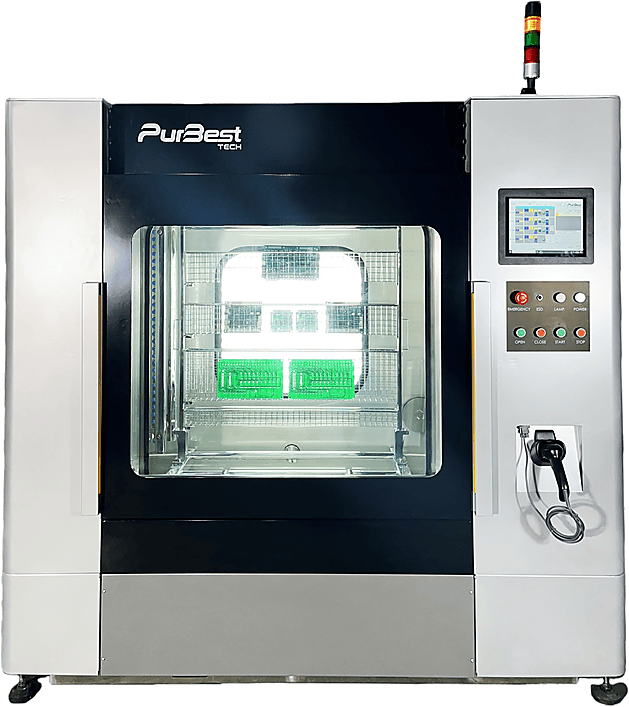
Maximum Cleaning Capacity
The Hydro-clean MAX handles workpieces up to 1500 × 700 mm (59 × 27.5 in) — the largest cleaning envelope in the Hydro-clean family. This covers oversized stencils, large mesh plates, full-size LED panel PCBs, backplanes, and misprinted boards that won’t fit in any standard cleaning machine.
Key Specifications
| Maximum Cleaning Size | 1500 × 700 mm (59 × 27.5 in) |
| Primary Application | Oversized stencil and mesh plate cleaning |
| Secondary Applications | Large-format PCBA cleaning, misprinted board recovery |
| Cleaning Technology | Spray-based — chemistry delivery across full workpiece surface |
| Process Cycle | Chemistry spray → DI water rinse → Drying |
| Paste Removal | Dissolves solder paste buildup in stencil apertures |
| Board Recovery | Cleans misprinted boards for reprinting — saves expensive substrates |
Control System: Windows OS with touchscreen HMI — programmable recipe storage/recall, cycle data logging, password-protected process parameters, and exportable production records for traceability (IPC-6012, MIL-STD-883, AS9100).
Applications
- Oversized stencil cleaning — removing solder paste from apertures on stencils exceeding standard dimensions
- Mesh plate cleaning — thick-film and fine-mesh printing screens used in LED and display manufacturing
- Large-format PCBA cleaning — LED panels, industrial control boards, backplanes, and server motherboards
- Misprint board recovery — cleaning boards with incorrect paste deposits for reprinting instead of scrapping
- Stencil life extension — regular cleaning maintains aperture integrity and print consistency
Why Stencil Cleaning Matters
A clogged stencil aperture deposits less paste than intended. On a 0.5mm (0.020 in) BGA pad, a 20% paste reduction means an insufficient solder joint — which passes visual inspection but fails under thermal cycling. Stencil cleaning isn’t cosmetic — it’s process control. The MAX ensures every aperture delivers the correct paste volume, board after board, shift after shift.
Hydro-clean MAX vs. Alternatives
| Feature | Hydro-clean MAX | Manual Solvent Wipe | Standard Stencil Cleaner |
|---|---|---|---|
| Maximum stencil size | 1500 × 700 mm (59 × 27.5 in) | Unlimited (manual) | ~737 × 737 mm (29 × 29 in) |
| Aperture penetration | Spray — consistent across full surface | Variable — operator dependent | Good — but size limited |
| Large-format PCBA | Yes — up to max envelope | Impractical | No |
| Misprint recovery | Yes — clean and reprint | Risky — may damage pads | Size limited |
| Repeatability | Automated cycle — identical every time | Poor — varies by operator | Good |
| Throughput | Batch — one large piece per cycle | Slow | Faster — but can’t handle the size |
What to Send for a Quote
- Stencil/mesh plate dimensions — length × width × frame thickness
- Board dimensions — if also cleaning large-format PCBAs
- Solder paste type — leaded, lead-free, water-soluble, no-clean
- Cycle time requirement — how many stencils per shift
- Contamination level — light (between shifts) vs. heavy (end-of-run)
- Chemistry preference — aqueous, semi-aqueous, or specific brand
Target Industries
LED panel manufacturing, display assembly, backplane production, industrial electronics, large-format PCB fabricators, contract manufacturers running oversized stencil programs.
Related Equipment
- Hydro-clean LRS — standard stencil and screen cleaning for stencils within conventional dimensions
- Hydro-clean AS — automatic PCBA cleaning with linear direct spray for populated boards
- Hydro-clean ARRAY — inline continuous cleaning for integration into SMT production lines