
The Problem This Machine Solves
After reflow, every PCBA carries flux residue — rosin-based, water-soluble, or no-clean formulations that all leave ionic contamination under components. On boards with fine-pitch QFP (0.4mm lead spacing), BGA, or CSP packages, that residue traps moisture, creates dendritic growth paths, and causes field failures months later. Manual cleaning with swabs and solvent bottles doesn’t reach under components and introduces variability that no quality system can tolerate.
Why Linear Direct Spray
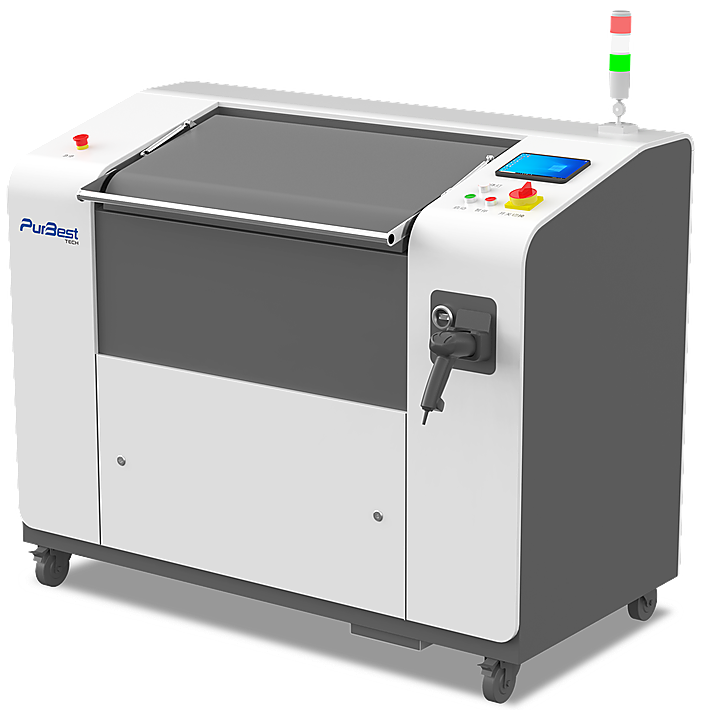
The Hydro-clean AS uses linear direct spray technology — a nozzle array that sweeps across the board in a linear pattern, delivering cleaning chemistry at controlled pressure and flow rate. Unlike ultrasonic cleaning (which can damage fine-wire bond pads) or simple flood rinse (which doesn’t penetrate under components), linear direct spray creates enough mechanical force to flush contaminants out from under low stand-off packages while maintaining consistent coverage across the entire board surface.
The spray pattern eliminates shadow zones — areas behind tall components that miss cleaning in less sophisticated systems. Every square centimeter of the board receives the same chemistry exposure and rinse volume.
Key Specifications
| Spray Technology | Linear direct spray — programmable sweep pattern |
| Door System | Automatic — operator loads/unloads, machine handles the rest |
| Process Cycle | Wash → Rinse I → Rinse II (optional) → Drying |
| Drying Technology | Hot air knife — direct impingement drying |
| DI Water System | 100% filtration of entire DI water circuit |
| Board Fixturing | Standard and custom PCBA fixtures; stencil clamping |
| AGV Integration | Optional — for automated production line material flow |
| Pipeline Design | Fully isolated — wash, rinse, and dry circuits separated |
| Monitoring | Extra-large transparent viewing window; proportional level sensors |
| Consumption | Low chemical and DI water usage — closed-loop recirculation |
Control System: Windows OS with touchscreen HMI — programmable recipe storage/recall, cycle data logging, password-protected process parameters, and exportable production records for traceability (IPC-6012, MIL-STD-883, AS9100).
Applications
- Post-reflow flux cleaning — rosin, water-soluble, and no-clean flux residue removal on boards up to full SMT panel size
- Fine-pitch assemblies — QFP with 0.4mm (0.016 in) lead spacing, TSSOP, SSOP
- Low stand-off packages — BGA, CSP, QFN, BTC, MELF, flip-chip with standoff down to 0.15mm (0.006 in)
- Misprint board recovery — cleaning boards with incorrect paste deposits for reprinting
- Pre-coating preparation — ensuring conformal coating adhesion by removing all ionic contamination
- Pre-wirebond cleaning — removing handling contamination before wire bonding operations
- Power electronics — cleaning IGBT modules, MOSFET assemblies, and power supply boards
- FOD removal — foreign object debris from handling and board manufacturing processes
How It Works — The Full Cycle
Step 1 — Wash: Operator loads the PCBA into the fixture and closes the door. The automatic cycle begins. Linear spray nozzles deliver heated cleaning chemistry (typically a saponifier or neutral pH aqueous solution) across the board at controlled pressure. Chemistry dissolves flux residue, solder paste contamination, and organic soils. Cycle time: 3–8 minutes depending on contamination level.
Step 2 — Rinse I: Fresh DI water rinse removes chemistry and dissolved contaminants. The rinse water is filtered and recirculated through the closed-loop system. 100% filtration ensures no particulate re-deposition.
Step 3 — Rinse II (optional): Second DI water rinse for applications requiring ultra-low ionic residue — MIL-STD-2000, IPC-6012 Class 3, or space-grade cleanliness specifications. Optional but recommended for high-reliability assemblies.
Step 4 — Drying: Hot air knife technology directs high-velocity heated air across the board surface, under components, and through via holes. Removes all moisture — critical for preventing corrosion under BGAs and inside blind vias. Drying time: 2–5 minutes depending on board complexity and thermal mass.
Hydro-clean AS vs. Alternatives
| Feature | Hydro-clean AS | Manual Solvent Clean | Ultrasonic Bath | Basic Spray Machine |
|---|---|---|---|---|
| Under-component cleaning | Yes — linear spray penetrates | No — swabs can’t reach | Yes — but risks wire bond damage | Partial — shadow zones behind tall parts |
| Automation level | Full auto — AGV-ready | Manual | Manual load/unload | Semi-auto |
| DI water rinse | 100% filtered, closed-loop | No — solvent only | Optional | Basic |
| Drying | Hot air knife — no moisture trapping | Air dry — risk of pooling | Air dry | Basic hot air |
| Process documentation | Level sensors, cycle logging | None | Timer only | Basic |
| Wastewater | Closed-loop — minimal discharge | Solvent evaporation | Drain | Drain |
What to Send for a Quote
- Board dimensions — maximum length × width × thickness
- Component profile — tallest component height; lowest stand-off gap
- Flux type — rosin, water-soluble, no-clean, or mixed
- Cleanliness spec — IPC-6012 class, MIL-STD-2000, NASA-STD-8739, or internal spec
- Throughput requirement — boards per hour or shift
- Stencil sizes — if the machine will also clean stencils
- Line integration — standalone or inline with conveyor? AGV compatibility needed?
- Chemistry preference — aqueous saponifier, semi-aqueous, or specific brand
Target Industries
Automotive electronics, industrial controls, telecommunications, consumer electronics, LED lighting, power supplies, medical devices, military/aerospace (Class 3), EMS providers running high-volume SMT lines.
Related Equipment
- Hydro-clean LDS — same linear direct spray, optimized for low stand-off packages with triple cleaning capacity and zero-discharge closed-loop
- Hydro-clean LTS — triangle spray for high-volume batch cleaning where throughput matters more than low-stand-off penetration
- Hydro-clean ARRAY — inline continuous cleaning for direct integration into SMT production lines