
Manual Wedge Bonder M60W — Ultrasonic Wire Bonding for Hybrid & Microelectronics
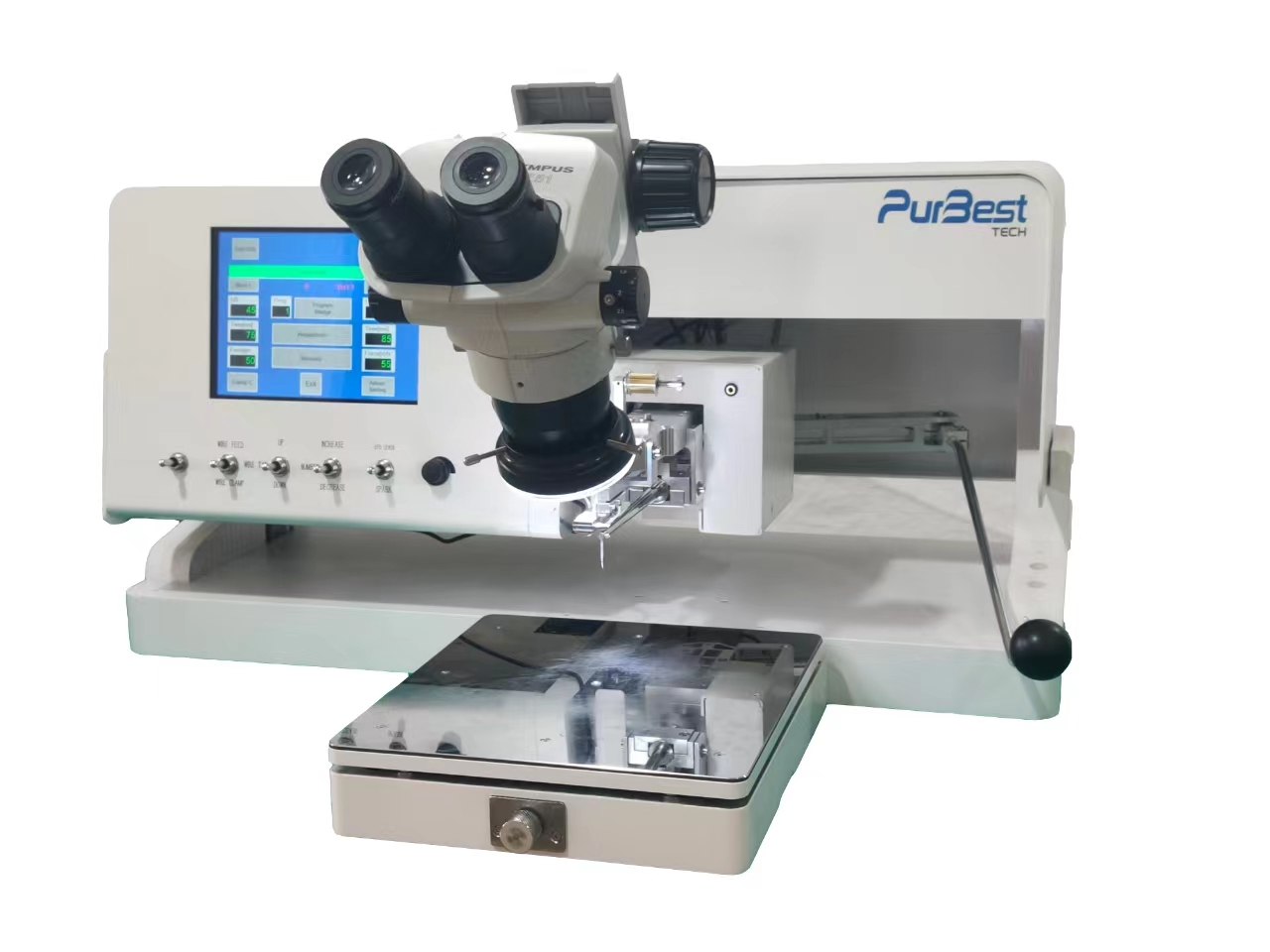
The M60W is a manual ultrasonic wedge bonder built for hybrid circuits, MCM multichip modules, optical devices, microwave assemblies, laser devices, and discrete component bonding. It operates with aluminum wire, gold wire, and gold ribbon — covering the full range of wedge bonding materials used in high-reliability microelectronics assembly.
Unlike ball bonders that require a flame-off ball formation step, wedge bonding creates a direct ultrasonic metallurgical bond between wire and pad. This gives the M60W lower profile interconnects, no heat-affected zone on the ball, and the ability to bond on pads that are too small or too close for ball bonding.
Key Specifications
| Bonding Type | Ultrasonic wedge bonding — aluminum wire, gold wire, gold ribbon |
| Wire Compatibility | Gold wire: 17–75 μm (0.0007–0.003″) Aluminum wire: 20–76 μm (0.0008–0.003″) Gold ribbon: up to 25 × 250 μm (0.001″ × 0.010″) |
| Deep Access | Yes — designed for recessed and high-profile package bonding |
| Motion Control | X, Y, Z operating levers for manual positioning at variable heights |
| Workbench | Height-adjustable for operator ergonomics across different workpiece sizes |
| Control System | Windows OS — easy operation, process parameter storage |
| Optics | Standard optics; optional adaptive microscope system for fine-pitch work |
| Ultrasonic Power | Adjustable — tuned per wire material, diameter, and pad metallization |
Wedge Bonding vs. Ball Bonding
Wedge bonding creates a direct ultrasonic bond — no ball formation, no flame-off, no gold sphere required. The wire is clamped in a wedge tool, pressed onto the pad, and bonded with ultrasonic energy. This produces:
- Lower profile interconnects — no ball height adds to package clearance requirements
- Smaller bond pad footprint — wedge bonds fit on pads too narrow for ball bonds
- Aluminum wire compatibility — ball bonding is limited to gold; wedge bonding handles both aluminum and gold
- Ribbon bonding capability — gold ribbon for high-current or low-inductance applications
- Deep access capability — bond inside recessed cavities, between stacked die, or in tall packages
For applications requiring both ball and wedge bonding on the same assembly, pair the M60W with a ball bonder — or use the PW22 semi-automatic bonder which supports both modes on one platform.
Primary Applications
- Hybrid microelectronics assembly
- Multi-chip module (MCM) wire bonding
- RF and microwave module assembly
- Optical device and fiber optic assembly
- Laser device wire bonding
- Discrete component interconnection
- High-reliability aerospace and defense electronics
- Prototype and low-volume production
- R&D laboratories and university research
- Failure analysis and qualification testing
When to Choose the M60W
The M60W is the right choice when your bonding requirements are wedge-only and manual control is acceptable. Typical scenarios:
- Hybrid circuit assembly — die attach has been completed, now wire interconnects are needed between die and substrate
- Microwave modules — gold ribbon bonding for low-inductance RF interconnects
- Deep access requirements — bonding inside cavities or between stacked die where automated bonders can’t reach
- Aluminum wire bonding — wedge bonding is the only ultrasonic method for aluminum wire on aluminum pads
- R&D and prototyping — low bond counts, high mix, frequent recipe changes
For higher throughput or mixed ball/wedge requirements, consider the PW22 semi-automatic bonder which adds motorized Z/Y, 100-program storage, and both ball/wedge capability.
What to Include in a Quote Request
- Wire material and diameter (aluminum wire, gold wire, gold ribbon — with gauge)
- Pad pitch and bond pad dimensions
- Package type and cavity depth (for deep access evaluation)
- Substrate material (ceramic, laminate, glass, silicon)
- Daily bond volume estimate
- Ultrasonic power requirements (per wire/pad combination)
- Microscope/optics needs (standard vs. adaptive)
- Quality standard (MIL-STD-883, IPC-6012, internal spec)
Configuration should be confirmed during application review.
Target Industries
Semiconductor packaging, hybrid microelectronics, RF/microwave modules, aerospace/defense electronics, optical device assembly, medical devices, university research labs, and failure analysis facilities.
Related Equipment
- PW22 Semi-Automatic Bonder — ball + wedge bonding with programmable recipes and motorized axis
- NanoVapor — precision substrate cleaning before wire bonding
- Vapor SUI Mini 2 — compact vapor phase cleaning for bonded assemblies
- Integrated Heating Stage — pre-heating for die attach and eutectic bonding before wire bonding
- SMSW II Spot Welder — resistance welding for ribbon and lead bonding applications