
The Problem This Machine Solves
Conformal coating protects electronics from moisture, chemicals, dust, and electrical leakage — but traditional spray and dip coating methods leave uneven thickness, pool in corners, and can’t reach under components. Parylene (poly-para-xylylene) coating solves this: it’s deposited from a vapor phase in a vacuum chamber, creating a truly conformal, pinhole-free film that coats every surface equally — including under BGAs, inside vias, and around fine wire bonds. The PDSV60 is a dedicated Parylene coating system with closed-loop process control for consistent, documented coating quality.
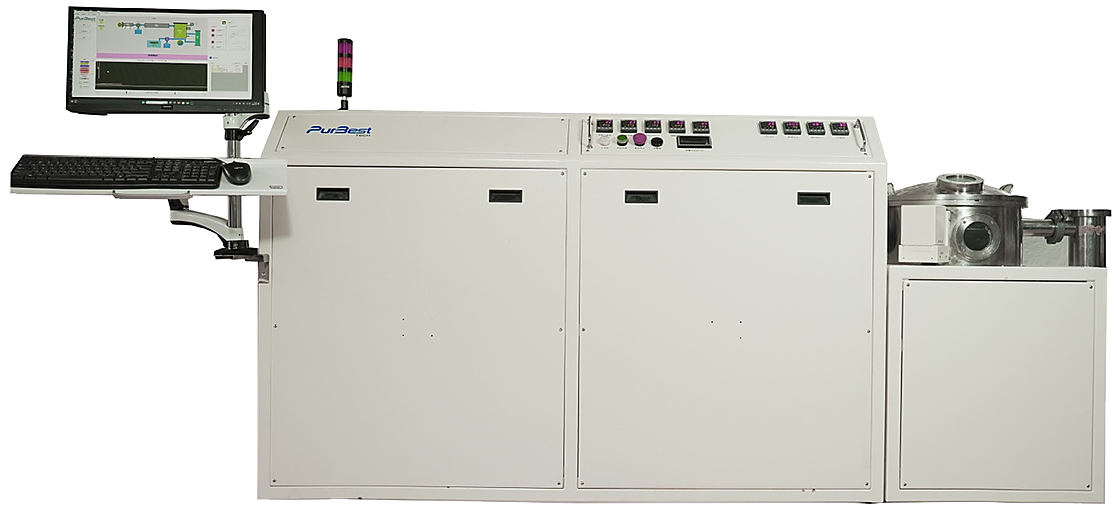
Vapor Phase Deposition — True Conformal Coating
Unlike spray coating (which produces directional thickness variation) or dip coating (which pools in recesses), Parylene is deposited through vacuum vapor deposition. The Parylene dimer is vaporized, pyrolyzed into reactive monomers, and deposited on all surfaces simultaneously in the vacuum chamber. The result: uniform thickness on horizontal, vertical, and underside surfaces — truly conformal coverage that no liquid coating process can match.
Key Specifications
| Coating Method | Vacuum vapor deposition — room temperature process |
| Operation Modes | Automatic and manual — dual mode for testing and production |
| Process Control | Closed-loop — temperature, pressure, and deposition rate |
| Control System | Full computer control — Windows OS, graphical interface |
| Deposition Chamber | Stainless steel electropolished — easy film removal, durable |
| Gas Distribution | Guide plate in sedimentation chamber — uniform coating |
| Evaporation Control | Evaporation valve — controls dimer flow to pyrolysis chamber |
| AP Device | Automatic evaporation coating of silane coupling agent |
| Status Monitoring | Operation status indicator lighthouse — visual status display |
| Process Protection | Parameter and alarm settings — monitor and protect coating process |
Control System: Windows OS with touchscreen HMI — programmable recipe storage/recall, cycle data logging, password-protected process parameters, and exportable production records for traceability (IPC-6012, MIL-STD-883, AS9100).
Applications
- Conformal coating of PCBAs — moisture and chemical protection for assembled circuit boards
- Hybrid circuit protection — coating of multi-chip modules and hybrid microcircuits
- MEMS coating — conformal protection of micro-electromechanical systems without affecting moving parts
- Medical device coating — biocompatible Parylene coating for implantable and surgical devices
- Optical device protection — moisture protection for optical sensors and fiber optic assemblies
- Aerospace electronics — coating for electronics exposed to vacuum, thermal cycling, and atomic oxygen
- Silane coupling agent application — automatic AP device for silane pre-treatment before coating
How It Works — The Parylene Process
Step 1 — Loading: The operator loads PCBAs or components into the electropolished stainless steel deposition chamber. The chamber is sealed and evacuated to vacuum.
Step 2 — Vaporization: The Parylene dimer (solid at room temperature) is heated in the evaporator, sublimating into a gaseous dimer. The evaporation valve controls the flow rate into the pyrolysis chamber.
Step 3 — Pyrolysis: The gaseous dimer passes through the pyrolysis furnace at ~680°C, breaking into reactive monomer radicals. These monomers are the active coating species.
Step 4 — Deposition: The monomers enter the room-temperature deposition chamber and polymerize on all surfaces simultaneously — forming a uniform, pinhole-free Parylene film. The guide plate in the sedimentation chamber ensures even gas distribution for consistent thickness.
Step 5 — Unloading: The chamber is returned to atmospheric pressure. Coated parts are removed with a truly conformal film — equal thickness on tops, sides, and undersides of all components.
PDSV60 vs. Alternatives
| Feature | PDSV60 (Parylene) | Spray Conformal Coating | Dip Coating |
|---|---|---|---|
| Coverage | Truly conformal — all surfaces equally | Directional — shadow zones | Pools in recesses |
| Thickness uniformity | ±5% across all surfaces | ±30% — directional variation | ±20% — pooling variation |
| Pinholes | Pinhole-free | Common — requires multiple coats | Occasional |
| Under-component coverage | Yes — vapor reaches everywhere | No — can’t reach under BGAs | Partial — trapped air bubbles |
| Process temperature | Room temperature — no thermal stress | Room temperature | Room temperature |
| Process documentation | Full computer control — logged parameters | Manual — operator dependent | Manual |
| Cost per board | Higher — dimer consumable | Lower | Lower |
What to Send for a Quote
- Board dimensions — maximum size to fit in deposition chamber
- Parylene type — Parylene C (most common), N, or D
- Target thickness — typically 0.5–50 µm (0.00002–0.002 in)
- Coating areas — full board or selective coating (masking required)
- Throughput — boards per batch or shift
- Quality spec — IPC-CC-830, MIL-I-46058, or internal spec
- Biocompatibility — medical device coating requires USP Class VI or ISO 10993
Target Industries
Medical device manufacturing, aerospace/defense electronics, automotive sensors, MEMS packaging, RF/microwave modules, optical devices, any facility requiring high-reliability conformal coating with documented process control.
Related Equipment
- Hydro-clean AS — post-solder cleaning before Parylene coating application
- NanoVapor — precision vapor phase cleaning of sensitive assemblies before coating
- VTP2000 — vacuum heating plate for pre-coating bake-out and outgassing reduction