
The Problem This Machine Solves
BGA, QFN, CSP, and flip-chip packages sit 0.05–0.25mm (0.002–0.010 in) above the board surface. That gap is too small for conventional spray cleaning to penetrate — the fluid can’t get under the package, so flux residue stays trapped underneath. Over time, that residue absorbs moisture, creates conductive dendrites between solder joints, and causes intermittent failures that are nearly impossible to diagnose. The standard Hydro-clean AS handles most SMT boards, but low stand-off packages need a machine specifically engineered for gap penetration.
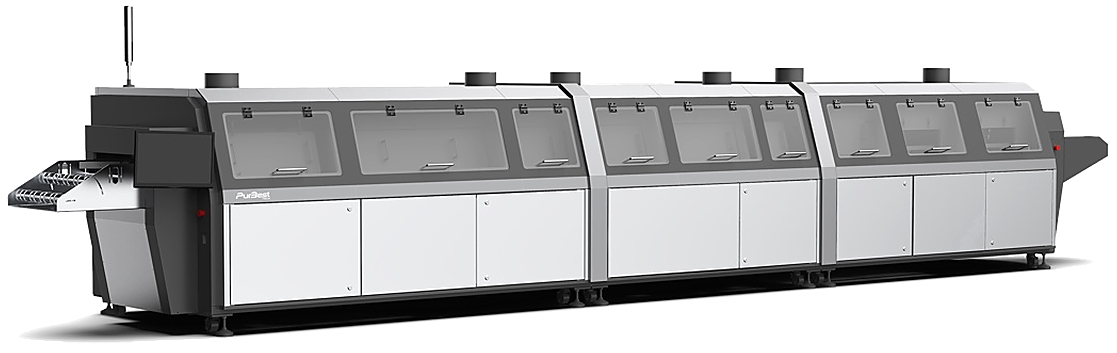
Why Linear Direct Spray for Low Stand-Off
The LDS uses the same linear direct spray platform as the AS, but with optimized nozzle geometry and higher impingement pressure designed to force cleaning chemistry into gaps as small as 0.05mm (0.002 in). The spray creates enough hydraulic force to flush contaminants out from under BGAs, QFNs, and CSPs — something ultrasonic cleaning can’t do reliably without risking damage to fine-wire bonds or solder joints.
The closed-loop zero-discharge system means all cleaning chemistry and DI water is recirculated and filtered — no drain connection required. Three completely independent liquid pipelines keep wash, rinse, and dry circuits separated, preventing cross-contamination between process stages.
Key Specifications
| Spray Technology | Linear direct spray — optimized for low stand-off gap penetration |
| Target Standoff | Down to 0.05mm (0.002 in) — BGA, QFN, CSP, BTC, MELF, flip-chip |
| Cleaning Capacity | Triple cleaning — wash, rinse I, rinse II (all process steps refineable into up to 5 sub-steps) |
| Liquid Pipelines | 3 completely independent closed-loop circuits |
| DI Water System | 100% filtration — zero-discharge closed-loop |
| Drying Technology | Hot air knife — direct impingement |
| Process Control | Visual window; proportional level sensors in all steps |
| Fixturing | Multiple standard and custom PCBA fixtures; stencil clamping |
Control System: Windows OS with touchscreen HMI — programmable recipe storage/recall, cycle data logging, password-protected process parameters, and exportable production records for traceability (IPC-6012, MIL-STD-883, AS9100).
Applications
- BGA cleaning — flux residue removal under ball grid array packages with standoff down to 0.05mm (0.002 in)
- QFN/DFN cleaning — thermal pad flux residue under exposed-pad packages
- CSP cleaning — chip-scale packages with minimal standoff
- Flip-chip assemblies — underfill-optional cleaning before underfill dispensing
- High-density mixed-technology — boards with both fine-pitch QFP and low stand-off BGA/QFN
- Pre-coating cleaning — ensuring conformal coating adhesion under bottom-termination components
- Pre-wirebond cleaning — removing contamination before wire bonding on hybrid assemblies
- Power electronics — cleaning IGBT, MOSFET, and power module assemblies
How It Works — Triple Cleaning with Sub-Step Control
Wash stage: Heated cleaning chemistry delivered through optimized spray nozzles at higher pressure than standard spray machines. The increased impingement force drives chemistry into low stand-off gaps, dissolving flux residue under BGAs, QFNs, and CSPs. Each process step can be refined into up to 5 sub-steps — allowing separate pre-wash, main wash, and post-wash stages with different chemistry concentrations or temperatures.
Rinse stages: Two independent DI water rinse circuits (rinse I and rinse II) — each with 100% filtration. The triple-rinse configuration ensures all chemistry is removed from under low stand-off packages, where trapped chemistry is harder to rinse out than on open board surfaces. Optional second rinse adds a third DI water stage for space-grade cleanliness.
Drying: Hot air knife technology directs high-velocity heated air under components and through via holes. Critical for low stand-off packages where moisture trapping is most likely. The independent drying circuit ensures no carryover from wash or rinse stages.
Hydro-clean LDS vs. Alternatives
| Feature | Hydro-clean LDS | Hydro-clean AS | Ultrasonic | Vapor Phase (solvent) |
|---|---|---|---|---|
| Low stand-off penetration | Optimized — down to 0.05mm | Good — but not optimized for ultra-low standoff | Yes — but risks wire bond damage | Yes — but requires solvent consumables |
| Cleaning capacity | Triple — up to 5 sub-steps | Double (wash + rinse) | Single bath | Single solvent cycle |
| Liquid pipelines | 3 independent circuits | Isolated pipelines | Single bath | Closed solvent loop |
| Zero discharge | Yes — fully closed-loop | Closed-loop | No — drain required | Solvent recovery |
| Wire bond safety | Safe — spray, not ultrasonic | Safe | Risk of bond damage | Safe |
| Process flexibility | 5 sub-steps per stage | Standard | Limited | Limited |
What to Send for a Quote
- Board dimensions — maximum length × width × thickness
- Low stand-off packages — BGA, QFN, CSP types and quantities per board
- Minimum standoff height — critical spec for nozzle optimization
- Flux type — rosin, water-soluble, no-clean
- Cleanliness specification — IPC-6012 class, MIL-STD-2000, or internal spec
- Throughput requirement — boards per hour or shift
- Rinse configuration — standard double rinse or optional triple rinse
- Sub-step requirements — if process requires multi-stage wash chemistry
Target Industries
Semiconductor packaging, RF/microwave module assembly, medical device electronics, military/aerospace (MIL-STD-883), automotive ADAS, 5G infrastructure, any facility assembling boards with BGA, QFN, or CSP packages.
Related Equipment
- Hydro-clean LDS-S — same LDS technology in single-frame or double-frame configurations for flexible production layouts
- Hydro-clean AS — automatic PCBA cleaning with linear direct spray for standard stand-off assemblies
- Vapor SUI Mini 3 — co-solvent vapor phase cleaning for the tightest stand-off gaps where aqueous cleaning reaches its limit