
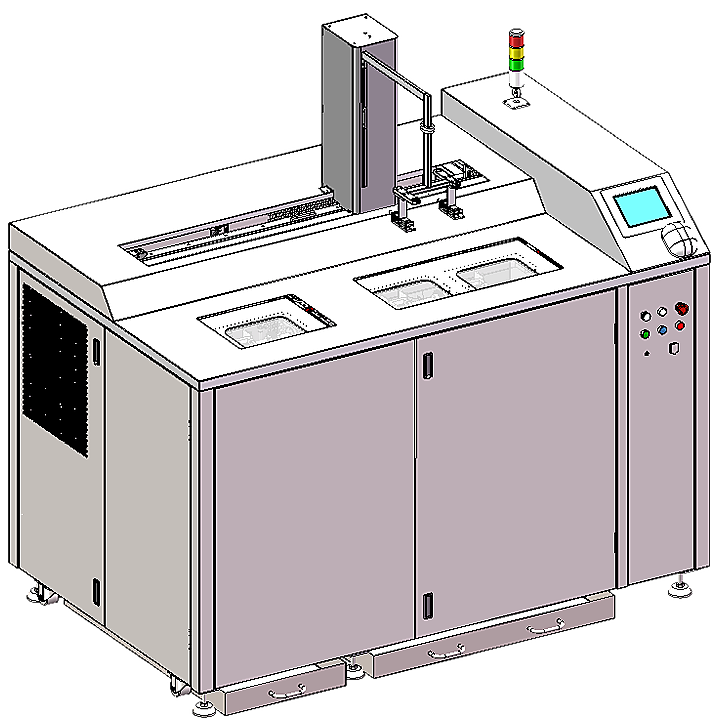
The Vapor SUI Mini 3 is a compact co-solvent vapor phase cleaning machine — the most powerful cleaning option in the compact footprint category. It uses a two-chemistry process: a heavy-duty non-volatile cleaning agent dissolves the toughest contamination, then a volatile rinse solvent washes it away and dries the assembly clean. This handles residues that single-solvent systems cannot.
Why Vapor SUI Mini 3 Exists
Some contamination — high-temperature flux residues, underfill material, baked-on organics — resists single-solvent cleaning. The co-solvent process addresses this by using two chemistries in sequence: a heavy-duty agent for dissolution, followed by an HFE rinse for residue-free drying. The Vapor SUI Mini 3 brings this capability to the compact equipment category.
Key Specifications
| Cleaning Technology | Third-generation co-solvent — heavy-duty agent + HFE rinse |
| Spray-Under-Immersion | Yes — with double-flow cleaning up to 300L/min (79 gal/min) |
| Ultrasonic | Optional 132 kHz — not required |
| Basket Oscillation | Yes — mechanical agitation |
| Vapor Rinsing | Multiple cycles for process flexibility |
| Solvent Management | Dual condensation + dual sealing — minimal loss |
| Closed-Loop | Fully closed — no wastewater discharge |
| Construction | Stainless steel, compact footprint |
| Control | Industrial computer, programmable cycles |
Control System: Windows OS with touchscreen HMI — programmable recipe storage/recall, cycle data logging, password-protected process parameters, and exportable production records for traceability (IPC-6012, MIL-STD-883, AS9100).
Applications
- Bare chip cleaning — surface preparation before wire bonding or die attach
- 3D packaging component cleaning — stacked die with micro-gap interconnections
- Micro-gap ultra-precision cleaning — stand-off gaps below 0.3mm (0.012″)
- SIP and microwave component cleaning — frequency-sensitive assemblies
- Pre-packaging cleaning — before encapsulation or molding
- Pre-coating cleaning — ensuring conformal coating adhesion
- Post-lead-tinning cleaning — removing flux residue after component tinning
- Low stand-off components — FC, BGA, CSP, BTC, QFN, MELF packages
- Water-free environments — facilities with wastewater discharge restrictions
Co-Solvent Process Explained
The co-solvent process works in two steps:
- Heavy-duty cleaning agent — a non-volatile solvent dissolves tough contamination (high-temp flux, underfill, baked-on organics). The part is immersed and sprayed with this agent, with basket oscillation for mechanical action.
- HFE rinse — a volatile hydrofluoroether solvent washes away the cleaning agent and dissolves any remaining residue. The HFE evaporates cleanly, leaving the assembly dry and contamination-free.
This two-step approach delivers cleaning power that single-solvent systems cannot match, while maintaining the compact footprint and water-free operation of the Mini platform.
When to Choose Co-Solvent vs. Single Solvent
| Contamination Type | Single Solvent | Co-Solvent (Mini 3) |
|---|---|---|
| Standard flux residue | Effective | Effective |
| High-temperature flux | May require extended cycles | Designed for this |
| Underfill residue | Limited | Effective |
| Baked-on organics | Limited | Designed for this |
| Light oils and fingerprints | Effective | Effective |
| Complex geometries with mixed residue | Variable | Best choice |
Related Equipment
- Vapor SUI Mini 2 — single-solvent compact vapor phase for standard contamination
- Vapor SUI 2 — full-size single-solvent for production volumes
- NanoVapor — vacuum vapor phase for maximum penetration